How to teach density and buoyancy with an interactive simulation
Use the same object in two fluids so density is the only reason the outcomes differ. Compare weight and buoyant force while the object moves, then show that a floating object settles when reduced displaced volume makes those forces equal.
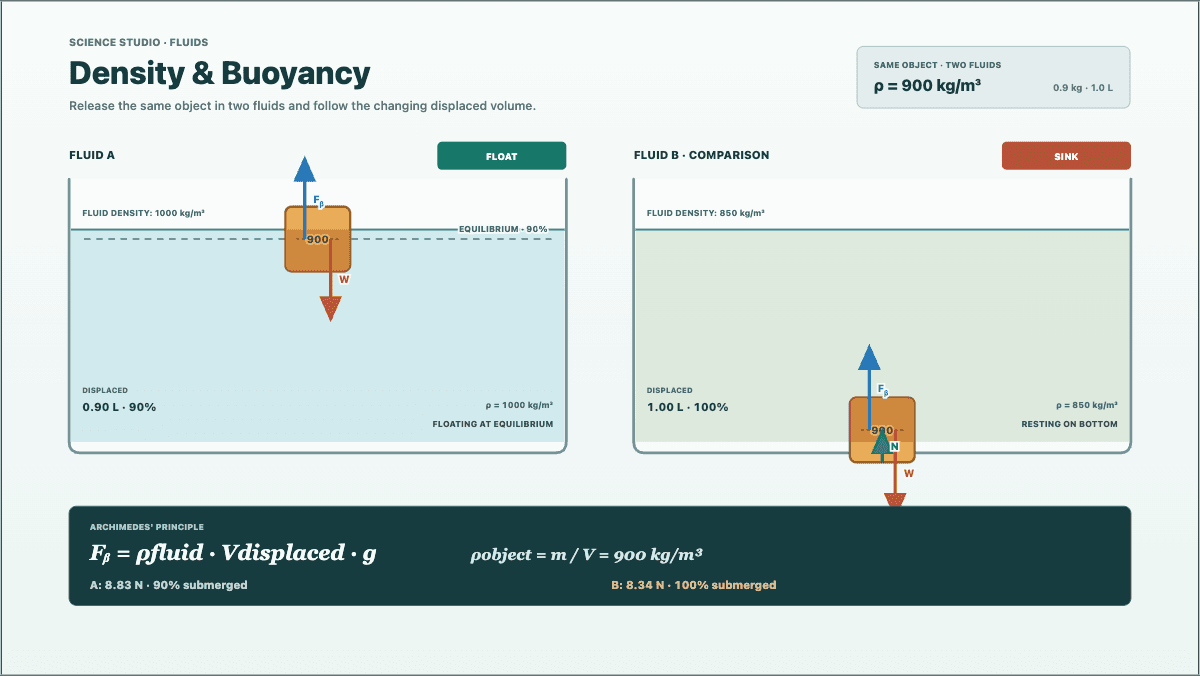
Students can use density to predict the direction of motion and force balance to explain the final state.
Move from a density prediction to a force explanation.
- 1
Predict from density
Show the object density and the two fluid densities before release. Students predict rise, sink, or suspension in each fluid and explain the comparison they used.
- 2
Release the same object
Run both containers from the same starting depth. Because the object is identical, any difference in motion must come from the fluid and the forces it produces.
- 3
Pause on the force diagram
Compare weight with buoyant force while the object is fully submerged. Identify the direction of the net force before discussing the final position.
- 4
Follow the floating object
As the object rises out of the fluid, displaced volume decreases. Pause when buoyant force equals weight and connect that balance to the submerged fraction.
- 5
Test a boundary case
Set object density equal to fluid density. With zero initial velocity, the ideal model suspends the object because buoyant force and weight balance at full submersion.
Separate the motion question from the force question.
Large objects always sink
Size alone does not decide the outcome. Average object density compared with fluid density predicts whether a fully submerged object initially rises or sinks.
A floating object has no weight
Weight still acts downward. At rest, the upward buoyant force has the same magnitude, so the net vertical force is zero.
Buoyant force is always constant
For an incompressible fluid it depends on displaced volume. It stays constant while a rigid object is fully submerged, then decreases as a floating object emerges.
What the animation and measurements should agree on.
Object is denser
Weight exceeds the fully submerged buoyant force, so the initial net force is downward and the object sinks.
Object is less dense
The fully submerged buoyant force exceeds weight, so the object rises until a smaller displaced volume produces equilibrium.
Densities match
For a fully submerged object released from rest, buoyant force equals weight and the ideal object remains suspended.
The comparison assumes uniform density, incompressible fluids, and constant gravity.
The displaced-fluid relationship follows OpenStax College Physics 2e, 11.7: Archimedes' Principle. Drag affects how quickly the object settles, but the final floating condition comes from buoyant force balancing weight.
Release one object into two different fluids.
Track displaced volume, weight, buoyancy, drag, and the final force balance in one synchronized classroom view.