How to teach electromagnets with an adjustable solenoid
An electromagnet's field is created by moving charge. Increase current or coil turns to strengthen the ideal solenoid field, reverse current to reverse its poles, and use the right-hand grip rule to predict the field direction.
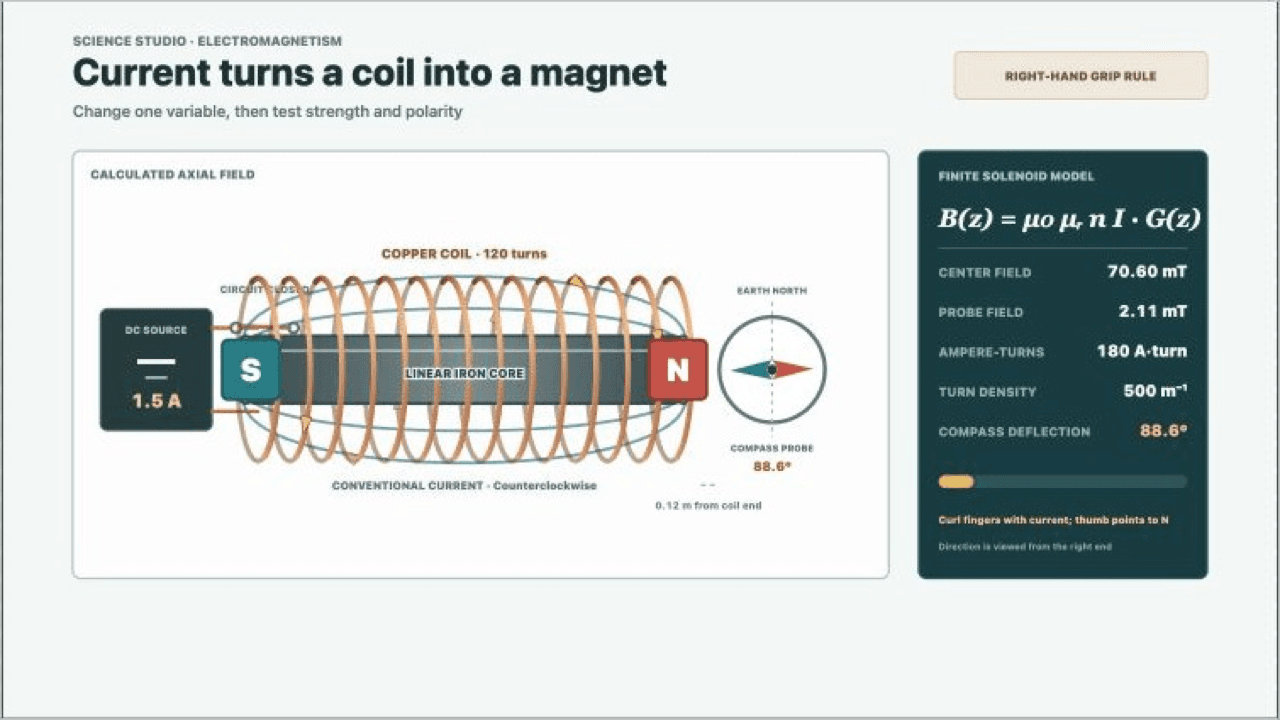
Students can connect a visible current direction to a solenoid's pole direction and relative field strength.
Use current reversal as the cleanest test of magnetic-field direction.
- 1
Identify a solenoid
Show the coil, battery, current arrows, and compass. Ask students whether the coil should have one pole, two poles, or no magnetic effect.
- 2
Predict with the right hand
Have students curl their right-hand fingers in the current direction. Their thumb predicts the field direction through the coil and the north end.
- 3
Reverse the current
Swap the battery direction while keeping turns and current size fixed. The compass response and north-south labels should reverse together.
- 4
Increase coil turns
Return to the original direction and add turns. Compare the field-strength indicator while all other controls remain fixed.
- 5
Add a core
Introduce the iron core as a material response that concentrates the field. Contrast this with the direction change caused by reversing current.
Make students explain the evidence, not just name the effect.
The center particles are electrons leaving the coil
They visualize the field, not individual charge carriers. Electrons drift through the wire while the magnetic field extends around the coil.
More turns reverse the poles
More turns strengthen the ideal field for the same current direction. Reversing current changes which end is north.
A coil has only one magnetic pole
A solenoid behaves like a bar magnet with a north and south end, joined by continuous field lines.
What the animation and measurements should agree on.
Reverse current
The north and south labels exchange, and the compass deflection reverses because the magnetic-field direction reverses.
Add turns
With the same current and coil length, more turns per length create a stronger ideal field.
Add an iron core
The core increases the field response by becoming magnetized, but it does not set the direction independently of the current.
The comparison starts from the magnetic field produced by current in an ideal solenoid.
OpenStax College Physics 2e, 22.9: Magnetic Fields Produced by Currents. Use the ideal relationship to compare one changed control at a time, then name the ways a physical coil differs from the model.
Questions teachers can use before or after the demonstration.
What changes when current through an electromagnet reverses?
The magnetic-field direction reverses, so the solenoid's north and south poles exchange.
How can a solenoid be made stronger?
In the ideal model, increase current or turns per unit length. An appropriate iron core can also strengthen the field.
Run the comparison in the interactive experiment.
Keep one visible question on screen, change one parameter, then pause when the diagram and measurements answer it together.