How to teach levers and moments with a balance simulation
A beam balances when clockwise and counterclockwise moments are equal. Change force or perpendicular distance one at a time so students see why a smaller force can balance a larger one when it acts farther from the pivot.
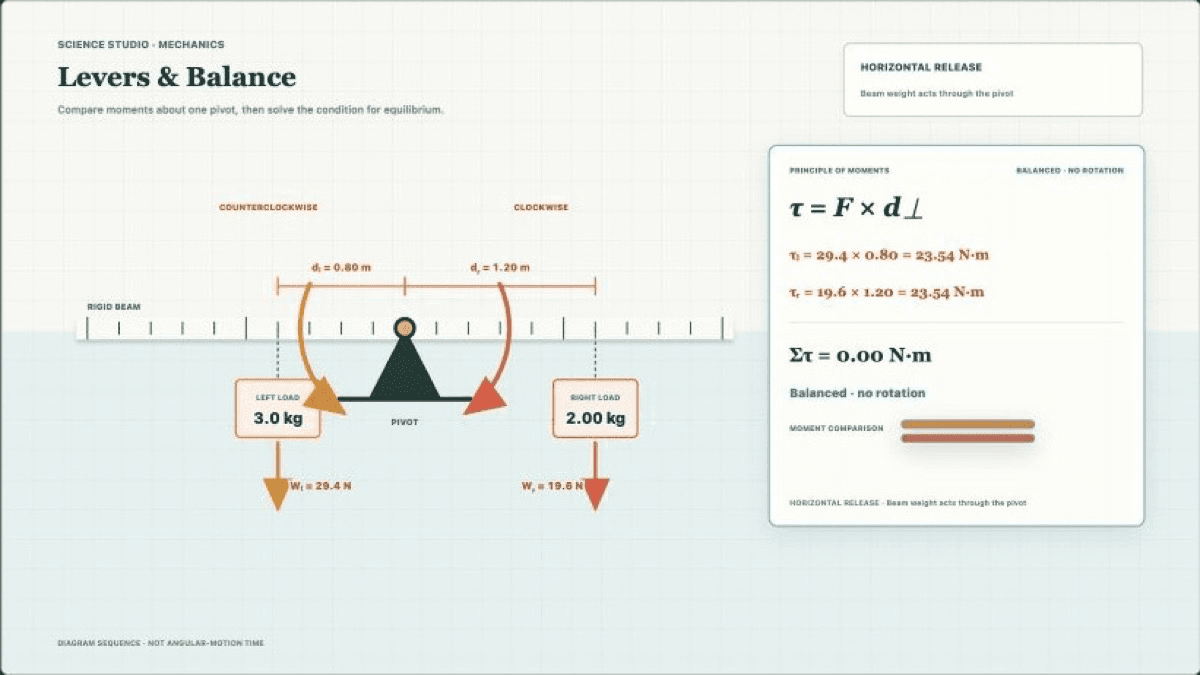
Students can calculate a moment and use opposite rotation directions to test rotational equilibrium.
Start with an unbalanced beam, then restore equilibrium by changing a single moment term.
- 1
Locate the pivot
Show an initially balanced beam and ask which quantities could make it rotate. Identify the pivot, force direction, and perpendicular distance.
- 2
Break the balance
Increase one load while keeping its position fixed. Students predict rotation direction before running the motion.
- 3
Restore with distance
Reduce the force or move the opposite load farther from the pivot. Pause when the displayed clockwise and counterclockwise moments match.
- 4
Test the same force twice
Keep one force fixed but place it at two different distances. Students compare why the farther load produces the larger turning effect.
- 5
Use a diagonal force
Show that only the component perpendicular to the lever arm creates the moment, then return to the right-angle classroom case.
Make students explain the evidence, not just name the effect.
The heavier side always goes down
Rotation depends on moment, the product of force and perpendicular distance. A smaller force farther out can win.
Distance means any point on the beam
The relevant distance is perpendicular from the pivot to the force's line of action.
A balanced beam has no forces
Forces still act. The net torque is zero, and vertical forces must also balance for static equilibrium.
What the animation and measurements should agree on.
Same force, farther out
The larger perpendicular distance creates the larger moment, so the beam rotates more strongly in that direction.
Different forces, equal moments
A small force at a long distance can balance a larger force close to the pivot.
Equal opposite moments
The beam remains at rest when clockwise and counterclockwise moments sum to zero.
The lesson uses the torque condition for rotational static equilibrium.
OpenStax University Physics Volume 1, 12.1: Conditions for Static Equilibrium. Keep the first example perpendicular to the beam so students can connect the visual distance directly to the moment calculation.
Questions teachers can use before or after the demonstration.
Can a lighter load balance a heavier load?
Yes. It must act at a proportionally greater perpendicular distance so the two moments have equal magnitude.
Why does the distance need to be perpendicular?
Only the component of a force perpendicular to the lever arm changes the turning effect about the pivot.
Run the comparison in the interactive experiment.
Keep one visible question on screen, change one parameter, then pause when the diagram and measurements answer it together.