How to teach momentum conservation with a collision simulation
Treat the two carts as one system during the short collision. If external impulse is negligible, total momentum before and after is the same even when the carts bounce differently or kinetic energy changes.
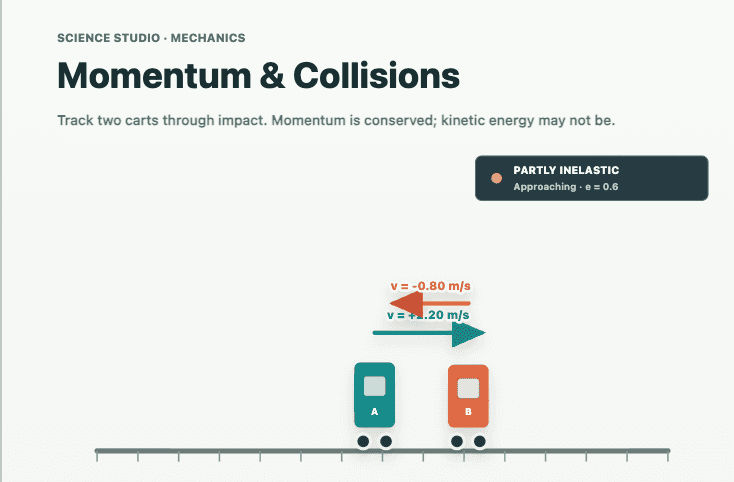
Students can calculate system momentum and separate momentum conservation from kinetic-energy conservation.
Make the system boundary explicit before comparing the two collision states.
- 1
Define the system
Show the two carts, their masses, and their velocities. Ask students which quantities belong to each cart and which quantity belongs to the two-cart system.
- 2
Predict the result
Set unequal masses and one moving cart. Students calculate the initial total momentum before the collision begins.
- 3
Run an elastic collision
Pause immediately after the collision. Compare each cart's changed velocity with the unchanged total system momentum.
- 4
Change restitution
Repeat with a lower coefficient of restitution. Students see that the carts may leave together or more slowly while total momentum remains the same.
- 5
Compare energy separately
Show kinetic energy for both cases. Ask why momentum can be conserved even when kinetic energy decreases in an inelastic collision.
Make students explain the evidence, not just name the effect.
Momentum and kinetic energy are the same rule
Momentum is conserved for an isolated system, while kinetic energy is conserved only in an elastic collision.
The heavier cart keeps its velocity
Mass affects how much a cart's velocity changes, but both carts receive equal and opposite impulses during the collision.
A cart that stops has no momentum in the system
Its individual momentum is zero after stopping, but the other cart or the joined pair carries the system momentum.
What the animation and measurements should agree on.
Elastic
The carts exchange momentum while total momentum and total kinetic energy stay constant in the ideal elastic case.
Inelastic
Total momentum stays constant, but some kinetic energy transfers to internal energy, sound, or deformation.
Unequal masses
The lighter cart generally has the larger velocity change because the collision impulses have equal magnitude and opposite direction.
The comparison uses conservation of momentum for a system with negligible net external impulse.
OpenStax College Physics 2e, Chapter 8: Linear Momentum and Collisions. The simulation isolates the collision interval so students can compare the system before and after the interaction.
Questions teachers can use before or after the demonstration.
Is momentum conserved in an inelastic collision?
Yes, for an isolated system. Kinetic energy can decrease, but the total vector momentum before and after remains the same.
Why do carts move in opposite directions after a collision?
During contact they exert equal and opposite forces for the same time, producing equal and opposite changes in momentum.
Run the comparison in the interactive experiment.
Keep one visible question on screen, change one parameter, then pause when the diagram and measurements answer it together.