How to teach Ohm's law with an interactive circuit
Teach Ohm's law as two controlled comparisons, not as a triangle to memorize. Hold resistance fixed while voltage changes, then hold voltage fixed while resistance changes. Students can use the measured current to explain both patterns.
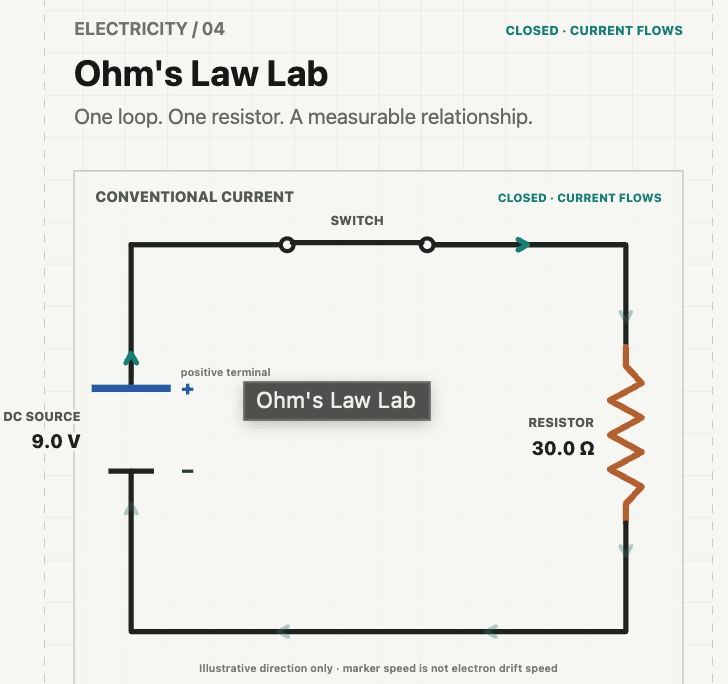
Students can predict whether current increases or decreases and justify the direction using I = V/R.
Two comparisons are enough to make the relationship visible.
- 1
Establish one complete circuit
Close the switch and identify the source voltage, resistance, and measured current. Ask students which quantity is the cause, constraint, and response in this first comparison.
- 2
Predict a voltage change
Keep resistance fixed and ask what happens to current if the source voltage doubles. Record the prediction before moving the control.
- 3
Test the voltage prediction
Double voltage without changing resistance. The measured current should double because the ratio V/R doubled.
- 4
Predict a resistance change
Return to the starting voltage, then double resistance. Students should predict that current becomes half as large.
- 5
State the relationship
Use both comparisons to explain I = V/R. Finish by opening the switch so students distinguish a calculated closed-circuit current from zero current in an incomplete path.
Correct the language before correcting the arithmetic.
Voltage flows through the circuit
Voltage is a potential difference between two points. Current is the rate of charge flow through the closed path.
The resistor uses up current
In a one-loop steady circuit, the same current passes through every point. The resistor transfers electrical energy; it does not consume charge.
V, I, and R can all be changed independently
For an ohmic resistor at a fixed temperature, any two quantities determine the third. A controlled comparison changes one input while holding the other fixed.
What the measurements should show.
Double V
At fixed resistance, doubling the source voltage doubles current. The ratio V/I remains equal to R.
Double R
At fixed voltage, doubling resistance halves current. The circuit still has one complete current path.
Open switch
An incomplete path has zero steady current, even though the source still maintains a potential difference.
The demo models an ideal DC source, wires, switch, and ohmic resistor.
The relationship and controlled comparisons follow OpenStax College Physics 2e, 20.2: Ohm's Law. Real components can change resistance as temperature changes, so the model's fixed-resistance assumption should be stated.
Run both Ohm's law comparisons in one circuit.
Adjust voltage and resistance independently, close or open the switch, and keep the measured current synchronized with the equation.