How to teach sound frequency and amplitude with a wave simulation
Frequency controls pitch and amplitude controls sound pressure variation. Change one control at a time: more compressions per second raise pitch, while a larger pressure swing makes the waveform taller without changing its pitch.
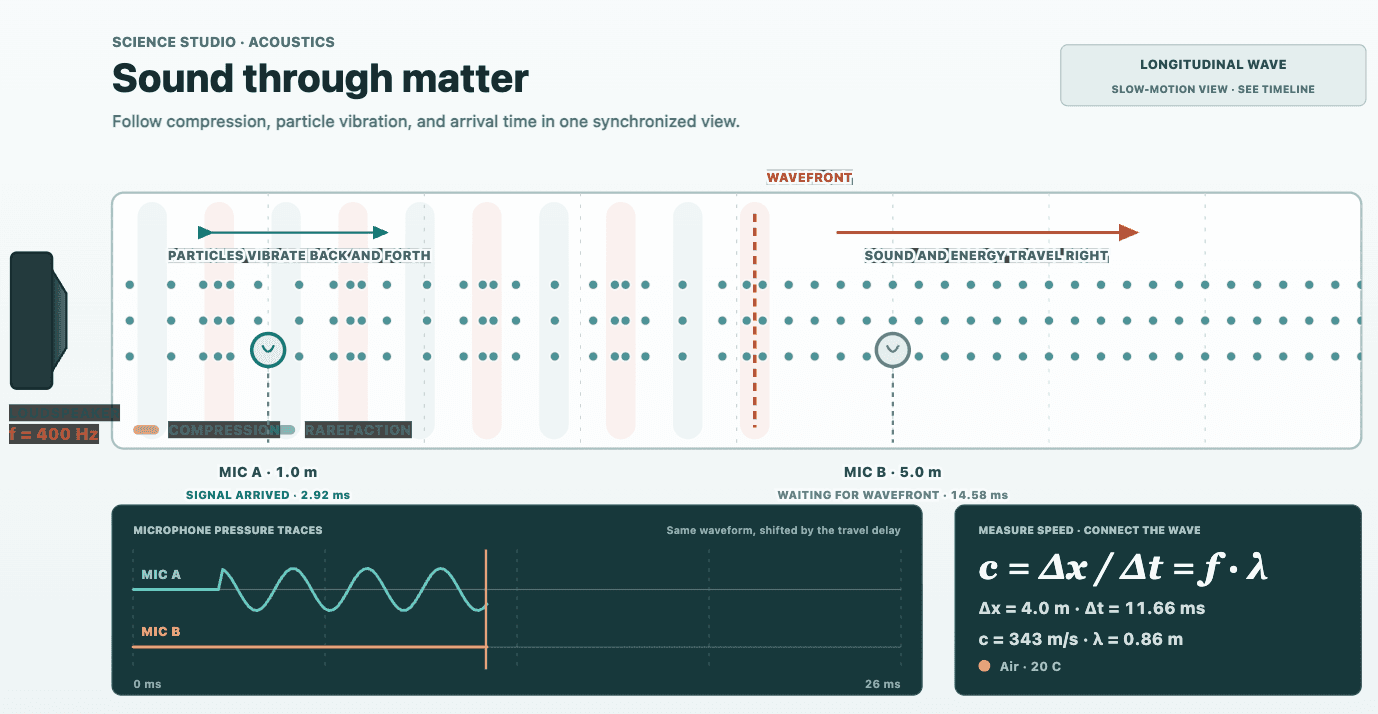
Students can identify which wave property changes when a sound becomes higher in pitch or larger in amplitude.
Hold the medium fixed so each sound change has one physical explanation.
- 1
Name the two views
Show the longitudinal particle pattern beside the pressure waveform. Ask students where a compression appears on the graph.
- 2
Change frequency only
Keep amplitude fixed and increase frequency. Students count more cycles in the same time interval and connect that to a higher pitch.
- 3
Change amplitude only
Return to the first frequency, then increase amplitude. The waveform becomes taller and the compressions stronger while the period stays the same.
- 4
Compare wavelength
For a fixed sound speed, increase frequency again. Students see wavelength decrease even though the medium has not changed.
- 5
Use a microphone point
Move the observation point and explain that the delayed waveform records the same wave after it travels through the medium.
Make students explain the evidence, not just name the effect.
A taller wave has a higher pitch
Amplitude changes pressure variation and perceived loudness. Pitch is determined mainly by frequency.
Sound particles travel with the wave
Air particles oscillate around equilibrium. The wave transfers energy and information through the medium.
Frequency and wavelength rise together
When sound speed is fixed, frequency and wavelength are inversely related.
What the animation and measurements should agree on.
Higher frequency
More cycles pass the microphone each second. The period and wavelength become smaller when sound speed is fixed.
Higher amplitude
Compressions and rarefactions are stronger and the pressure waveform is taller, while frequency can remain unchanged.
Propagation delay
A microphone farther from the source receives the same pattern later because the wave takes time to travel.
The lesson uses the relationship among wave speed, frequency, and wavelength in a uniform medium.
OpenStax College Physics 2e, 17.2: Speed of Sound, Frequency, and Wavelength. Use the equation after the visual comparison so students can state which value was held fixed and which value changed.
Questions teachers can use before or after the demonstration.
Does amplitude change the pitch of a sound?
No. In the simplified wave model, pitch depends on frequency while amplitude changes the size of the pressure variation.
Why does wavelength change when frequency changes?
For a fixed sound speed, v = f lambda. Increasing frequency therefore decreases wavelength.
Run the comparison in the interactive experiment.
Keep one visible question on screen, change one parameter, then pause when the diagram and measurements answer it together.